
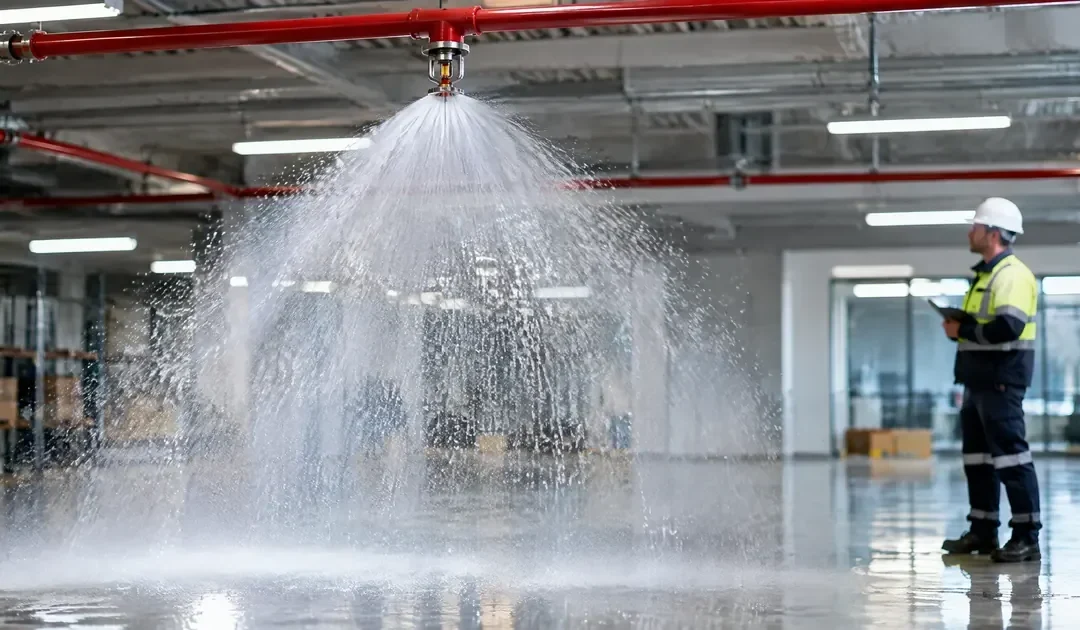
One of the most stubborn myths about fire sprinkler systems is the idea that they drench an entire building the moment one head activates. You have seen it in movies: one dramatic event, every sprinkler erupts simultaneously, and the lobby becomes a swimming pool. Real fire sprinklers do not work that way. In reality, a fire sprinkler system is an incredibly targeted and water-efficient tool, and understanding how much water a fire sprinkler puts out helps you see exactly why.
The actual numbers are worth knowing, whether you are a homeowner, a building manager, a developer, or just someone who wants to understand how these systems work. And the comparison between sprinkler flow rates and fire hose flow rates tells an important story about why sprinkler systems consistently cause far less water damage than the fires they suppress. Let’s get into the real data.
The Flow Rate Of A Single Residential Sprinkler Head
For residential quick-response sprinkler heads, the most commonly cited flow rate is between 13 and 26 gallons per minute. The American Fire Sprinkler Association (AFSA) and the National Fire Sprinkler Association (NFSA) both cite this range for standard residential heads. The City of Charleston’s municipal fire safety documentation cites 13 to 15 gallons per minute as the average output for a residential fire sprinkler, while NFSA materials reference 8 to 24 gallons per minute for quick-response heads depending on system pressure and head specification.
The actual flow rate for any specific head is determined by the head’s K-factor, a hydraulic constant, multiplied by the square root of the operating pressure at that head. This is calculated during the system design phase to ensure each head delivers the correct density of water to its coverage area. So when asking how much water a fire sprinkler puts out, the honest answer is that it varies by head type, K-factor, and operating pressure, but the residential range falls well within the figures above.
How Commercial Sprinkler Heads Compare
Commercial fire sprinkler systems, designed under NFPA 13 for larger and higher-hazard occupancies, often operate at higher flow rates than residential systems. Commercial standard-response heads may deliver 26 gallons per minute or more depending on the system design. Specialized heads like Early Suppression Fast Response (ESFR) sprinklers, used in high-rack warehouse storage applications, can deliver significantly higher flow rates to penetrate dense storage and suppress fires quickly at the source.
For an ESFR-protected warehouse with standard rack storage, how much water a fire sprinkler puts out can be a much larger number than a residential system, specifically because the hazard level demands it. The system design is matched to the building’s occupancy classification and the fire load it represents.
How Sprinklers Compare To Fire Hoses
Here is where the water-efficiency story gets compelling. The NFSA reports that quick-response residential sprinklers release 8 to 24 gallons per minute, compared to 50 to 125 gallons per minute from a fire hose. Charleston’s municipal data shows residential sprinkler output of 13 to 15 gallons per minute against 95 to 200 gallons per minute from a single fire hose under high pressure. The NFSA’s consumer materials note that the average sprinkler puts out 15 to 26 gallons per minute, while a single hose delivering water at fire department volume can push 150 to 250 gallons per minute.
Put those numbers in context: if a house fire takes approximately five minutes for the fire department to extinguish using a hose, more than 1,000 gallons of water are used. A single residential sprinkler head controlling the same fire before it escalates may use as little as 75 to 130 gallons in the same timeframe. The sprinkler system reduces water used to fight a fire by up to 90 percent compared to hose-based firefighting, according to AFSA data.
Only The Nearest Heads Activate
Another critical part of understanding how much water a fire sprinkler puts out is grasping that in virtually all real fire scenarios, only one or two heads ever activate. The NFSA data shows that 90 percent of all fires are controlled with six or fewer activated heads. A study covering 82 years of sprinkler use in Australia and New Zealand found that two or fewer sprinklers controlled 82 percent of all fires that occurred.
Each head activates independently based on the heat it detects. When a single head activates and extinguishes or controls the fire, the adjacent heads never reach activation temperature and never discharge. The total water used is limited to the output of the activated heads only, which is a key reason why water damage from a properly functioning sprinkler system is dramatically less severe than the damage caused by either an uncontrolled fire or a full fire department hose response.
Water Efficiency Is A Feature, Not An Accident
Understanding how much water a fire sprinkler puts out makes clear that these systems are engineered for efficiency. They deliver water at the precise point of origin of a fire, in the precise volume needed to suppress it, without flooding unaffected areas. That targeted response is why property damage in sprinklered buildings is approximately 70 percent lower than in unsprinklered ones, even accounting for the water used by the system.
Freedom Fire Protection designs and installs residential and commercial fire sprinkler systems throughout Northern California, with every system hydraulically calculated to deliver exactly the right flow rate for your building’s occupancy and layout.
If you have questions about how your system is designed or want to ensure it is properly maintained, contact our licensed team today.