
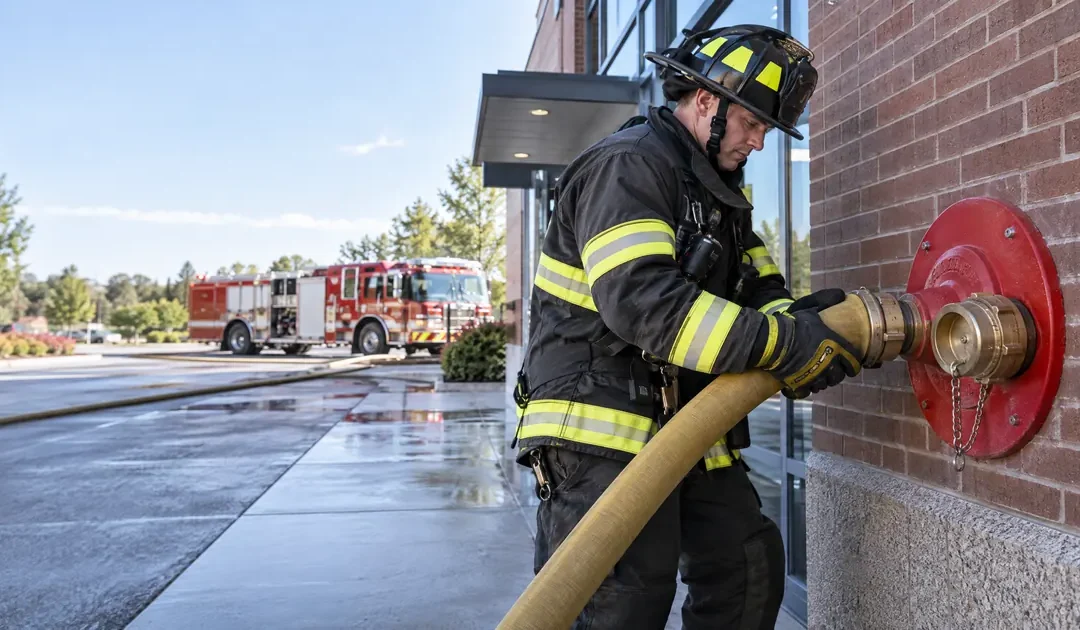
When firefighters arrive at a burning building, they need to act fast. But did you know that the building itself plays a role in helping them do their job? One of the most important and most overlooked pieces of fire protection equipment on any structure is the fire department connection, commonly referred to as the FDC. It is the external access point that lets emergency responders pump additional water directly into your fire sprinkler or standpipe system.
Understanding what a fire department connection does and how it works is valuable knowledge for any property owner or building manager. If the FDC on your building is damaged, blocked, or improperly maintained, it could affect the outcome of a fire emergency. Let’s break this down in plain terms.
What Is an FDC and What Does FDC Mean?
The term FDC, or fire department connection, refers to an inlet and piping system installed on the exterior of a building. FDC meaning is straightforward: it stands for Fire department connection, and it is exactly what its name implies. It is the point where a fire engine’s pumper truck connects to inject additional water pressure into the building’s sprinkler system during an active fire.
Most fire department connections look like a Y-shaped pipe protruding from the wall, with two 2.5-inch female swivel fittings. Firefighters connect their hose lines here to supplement the water already flowing through the system’s pipes.
How Does a Fire Department Connection Work?
So how does a fire department connection work in practice? When firefighters arrive at a fire, they attach a hose from their pumper truck to the swivel fittings on the FDC. They then pump water through the connection, which travels through an interior pipe and joins the building’s main fire sprinkler riser or main line. For more on this infrastructure, read what a fire sprinkler riser room is.
The fire department connection is not designed to replace the building’s municipal water supply. Fire sprinkler systems that comply with NFPA 13 typically draw water from the local municipal supply. The FDC supplements that supply to ensure sufficient water and pressure to suppress a serious fire effectively.
This backup becomes critical in three situations: when the municipal supply delivers insufficient water, when a valve is accidentally closed between the water source and the system, or when changes to the building’s occupancy since installation have created a greater fire hazard than the original system was designed to handle.
Where Is the FDC Located and What Are the Requirements?
According to NFPA 13, the fire department connection should be placed on the street-facing side of the building so firefighters can access it quickly. Some local jurisdictions require it on the address side of the building. Where that placement is not possible, such as in large shopping centers, the local authority having jurisdiction determines the best location. Placement can be considered as part of fire sprinkler installation planning.
The FDC must be clearly marked with a sign indicating the system type, the required inlet pressure, and whether it only supplies a portion of the building. It requires quarterly inspections to ensure swivel fittings move freely, caps are properly in place, and the check valve is operational. Every five years, the FDC must be flushed to clear any blockages that could prevent water from reaching the sprinkler system. Ask about fire sprinkler inspection services to help plan routine checks.
Do Not Let Your FDC Be an Afterthought
The fire department connection may not be the most visible part of your fire protection system, but it could be the most critical one during an emergency. A properly maintained FDC gives firefighters the backup they need to protect your building effectively.
At Freedom Fire Protection, we understand every component of your system.
Use our contact page today to discuss inspections and certifications that keep your system fully compliant and your fire department connection ready for whatever comes your way.